

watching ourselves float; watching ourselves sink*
On The Contents of a Life


One of the things about Substack that can work for or against a writer (and a reader) is that we’re able to track who we were at any given point in time, and how we’ve changed.
I suppose this is true for all creative workers; artistic evolution manifests in changes on the page or the canvas, and is directly correlative to whatever is going on in the art-maker’s life at the time. Sometimes, creatives follow trends instead of their hearts; I don’t think this ever works because it means they’re being guided by commodification, which is not to say I’ve been immune to it. But when I go back to something I’ve written in the past because — stylistically — that’s what was selling, I cringe in horror. Authenticity is important everywhere, but never more so than in love, friendship, and creative work: readers, music fans, art lovers, movie-goers all know when a writer isn’t being true to their voice, even as their voice is changing, which it invariably does with the passage of time.
I can create a timeline for the nearly twenty years that I’ve been writing Poor Man’s Feast — both here on Substack and first when it was a stand-alone narrative food(ish) blog: it started out as a place for readers to come for budget-friendly recipes, morphed into a collection of essays about sustenance both physical and emotional, and then evolved into a place where I found myself creating the foundation for three memoirs — Poor Man’s Feast, Treyf, and Motherland — and the hybrid, Permission. By the time I migrated the blog to Substack a few years ago, I was no longer the same person I was in 2008 when the former began: I had gone through a fair amount of familial, professional, and financial loss, and the essays reflect those changes both stylistically and contextually.
Why aren’t you the same chipper yuckster you were at the beginning, a relative asked me (they actually said yuckster), and I had to explain to them, Because I am not the same chipper yuckster I was when I started. My life had changed, and so had my work. And their lives had changed, too.
Mary Karr said it best: A kid has no control. You’re three feet tall, flat broke, unemployed, and illiterate. Terror snaps you awake.
So I guess it shouldn’t surprise me that my mother — as character, parent, nemesis — began to show up here more and more as my work as her caregiver began to inhabit every part of my life. Can’t you write about something else, some of my readers said, and my answer was Well, sure I can. And I did; I started to write about the things that were a direct extension of my yearning for ballast in my life — Susan and our home, and what it is like being a queer couple together for twenty-six years and now moving into our sixties and seventies; how I have fewer and fewer fucks to give when it comes to deceitful friends and colleagues, and how I can smell them a mile away; how I won’t tolerate bad behavior even from those I love, often to a fault; what my table life looks like, and how food in my home is no longer trendy the way it once had been; how gardening grounds me; how playing music — something I never really talked about until Katherine May mentioned it on her podcast the very first time we spoke — is like air and water for me, and how it has been since I was four, when I first picked up a guitar. It is so much an autonomic part of me that I don’t even think about it.
But when my life took a turn and I became — as many of you are — a primary caregiver to my (loving, enraged, talented, beautiful, furious, deceptive, manipulative, kind, cruel) mother, I could not help but write about this new role in which I found myself. And, from what you have told me, not only did it reflect who we were together, but it reflected back to many of you your own complicated relationships with elderly parents that maybe you were loathe to talk about or even think about, much less feel.
I’ve recently gotten a spate of notes from people, all of them strangers, telling me that in their opinion, it was time to change my tune — to write about something more fun, more ha ha, because no one wants to read relentless stories about a mother and a daughter who don’t get on. At first, I was upset. Then I was angry, because — sorry — however helpful they may think they’re being, no one should dictate what a writer writes, except for maybe an editor or an agent, and often not even then. I realized that my work was being considered a form of entertainment, like watching someone juggle flaming torches, or maybe cage fighting. They were not looking for engagement or god help me, revelation; they were, perhaps, looking for more of a mind-numbing distraction, like an hour playing Angry Birds or Candy Crush.
And so here I am, almost seven months to the day my mother died, and while I wanted to be able to say that I’m moving on, I’m moving forward, my life is now my own, it is irrevocably entwined with my mother’s in ways that are even more unalterable than I ever thought they’d be. Her ghost stays; she is everything and everywhere. Her boxes and bags of papers clutter my hallway and guestroom — we can’t even have friends come to stay over because it’d be like we were asking them to vacation in the Collyer Brothers’ mansion — and it takes hours and days to go through each of them, because there was zero organization. None. Not even an attempt. Giant plastic shopping bags — half a dozen of them — hold papers that contain her social security number as well as mine; tiny bits of paper with phone numbers scrawled on them, but no names; check registers dating back to my childhood that are like a time capsules: there are checks to our local dry cleaning lady, Telia, who had minimal teeth and carried a small bottle of gin in her gray smock, checks to a local boutique where my mother kept a running tab, checks to our Airedale’s groomer, and to the North Shore Animal League, for his euthanasia after he picked up parvo from the kennel she put him in every weekend. There is a photo of a newborn me, hours old, stuck to a letter of grievance written to the Supreme Court of the State of New York because the lawyer she hired after her second husband died had given her bad news about his estate, because he had never bothered to update his will when he married her, sixteen years earlier.
I continue to write my essays about my mother because writers search for containers to hold the chaos and the spiritual clutter. That is what we do.
If you were to visit me at this moment, and before I had the chance to offer you a cup of tea, you would enter through the front door and step over boxes of china (my grandmother’s), crates of bubble-wrapped Lladro and Lalique, Dansk and Arabica ceramics that belonged to my father when my parents married in 1962. If you were to climb over everything and make it down the hallway to the guest room. you would find plastic crates containing my mother’s purses, more shopping bags containing roughly a thousand publicity shots from 1995, when she recorded her CD, the contract she signed with the entertainment lawyer who promised her stardom, five hundred headshots from 1957 when she was on television, and telegrams and fan letters from people as remote as Wyoming and Newfoundland, where the writer, a gentleman captivated after seeing her on television, did everything but propose.
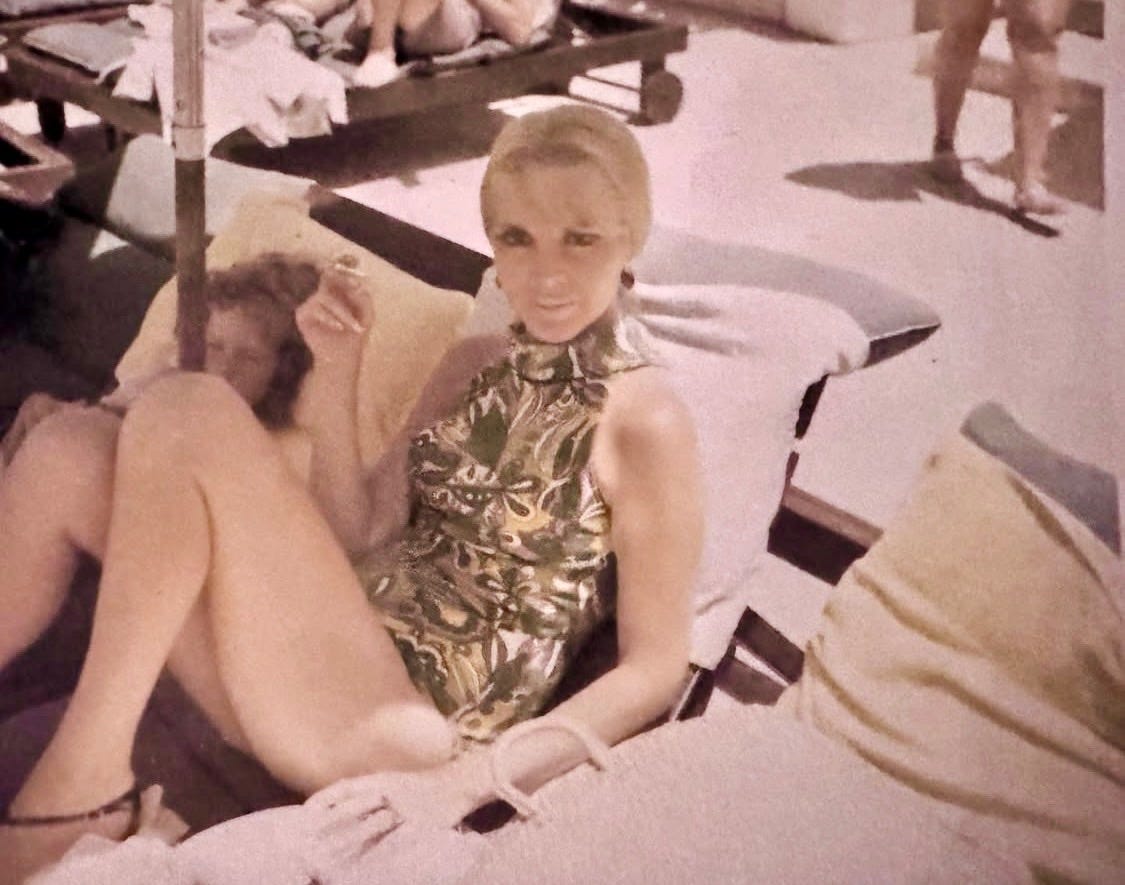
With every bag and box, I float; I look down into its contents as if it were a diorama, and I see the lives of two people lived in tandem unfolding as in a distant narrative, locked in time like a fly in amber. With every bag and box, I sink; I look down into its contents and I slip and fall into them because they not only represent her life, but mine — the cancelled private school checks from 1978, the grievance letters from 1997 when she was widowed and I became her primary relationship, the 2000 lawyer’s letter confirming the removal of my name from the deed of the apartment we co-owned a month after I introduced her to Susan, my signature on the transference documents forged by her, the scraps of paper where she practiced my signature, mindlessly stuffed into an envelope containing an electric bill — and I sink down and down under the weight of the psychic anarchy that she left me with, and that I don’t know how to carry.
In Stay, nick flynn answers an interviewer’s question:
Q: Can you talk a bit about your mother, place her in the frame of your story? Do you recognize her in yourself?

A: My mother is a ghost presence in Another Bullshit Night in Suck City, simply because that book focuses on how the trajectory of my life and the trajectory of my father’s life led us both into a homeless shelter for a few overlapping years. Yet my mother is the question behind everything we both do, hovering, both in her presence and in her absence, over us. Maybe there was no other place my father and I could have wrestled with the ghost of her but in that shelter, on those streets. And the question of how much of my mother I see in myself, I imagine we all hope that only the positive genes are passed on, but I don’t think it works that way.
At six years old, Flynn narrowly escaped a house fire set by his mother, who was trying to collect the insurance on it. At six years old, I narrowly escaped a car fire set by my mother, when she fell asleep with a smoldering cigarette stuffed into the passenger door ashtray of our Chrysler Imperial as my father drove us home through the night from Florida to New York, where his best friend, with whom my mother was having an affair, was in the hospital. The three of us and our Schnauzer, Binky, tumbled out of the car onto the macadam shoulder in the middle of a Georgia night; my father beat at the flame with the top of his polyester leisure suit. My mother and I sat side by side on the grassy median and watched as he tied his filthy white handkerchief to the blackened radio antennae: an SOS, a cry for help in the middle of the night, a thousand miles from home. Time is the fire in which we burn. I can tell you what I was wearing that night when I was a young child; I can tell you that I struggled to get my white sandals on so that when we jumped out of the car, the macadam wouldn’t hurt my feet; I can tell you that moments before my mother’s window exploded and I drifted in and out of sleep, Johnny Cash’s A Boy Named Sue was playing on the radio. Time is the fire in which we burn. Chaos. When I hear that song, which I almost never have since that summer of 1969, I smell melting automotive vinyl, the distinct chemical odor of burning electrical wire, my mother’s Jean Nate.
Some of us live our entire lives in utter chaos and clutter; with every bag I go through, I find evidence of my mother’s shambolic mind and nostril-flaring countenance. I remember her being so overwrought most of the time until the day she died that as a child, I did the only thing I could do: I took the blame for it. I took it on. I carried its weight. I made it a part of my own life and routine. Because, for the most part, children cannot possibly see their parents as dangerous; if they are to fully understand the emotional, spiritual, or physical danger they might be in at any given time, they would combust. It’s a paradox: the people charged with our care might be dangerous at a time when we have no agency. Mary Karr said it best: A kid has no control. You're three feet tall, flat broke, unemployed, and illiterate. Terror snaps you awake. It’s easier for a child to think of themselves as the villain, even when they’ve done nothing wrong but breathe.
I continue to write my essays about my mother because writers search for containers to hold the chaos and the spiritual clutter. That is what we do. We try to make sense of our lives, and attempt to see who we are now through the kaleidoscope of our past, our safety, our danger, our trauma. At sixty-two, I still struggle with understanding why I react to certain things the way I do, why I almost always begin a conversation with the narcissist’s lament: I’m sorry. Are you angry with me? My father couldn’t possibly have developed a violent temper because of his own abandonment traumas, his assumed inadequacies made real by his wife’s philandering. My mother couldn’t possibly have been effected by the rage that came with chronic creative disappointment, physical abuse at the hands of her own mother who knew no other way, and the desperate need for male approval. Instead, I assumed — as children do, because they must — that it was something I did.
Children cannot possibly see their parents as dangerous; if they are to fully understand the emotional, spiritual, or physical danger they might be in at any given time, they would combust.
So every weekend, I go through the letters and the boxes. I make piles: the one for the papers with my social security number, which will be shredded, the one for the papers that will go straight into the trash, and the one to re-read so that I can understand exactly who she was, and who I was, and who I am now. I look for evidence everywhere of the conflagration that was our lives.
I search for references to the car fire, but there is none. Not a single word.
*from Another Bullshit Day in Suck City, by nick flynn
Thank you, Elissa. I find your writing about the ways your family has shaped you helpful as I sort through these questions in my own life. Please keep writing what you need to write because there are many of us out here who need to read it.
I find it astounding that anyone would have the audacity to tell you what to write about — and it's not like I don't see wild comments regularly, but really, my mouth fell open when I got to that part. I am beyond grateful you aren't listening. Your writing about your mother, about caregiving, about complicated love and grief, about all of it, has been breathtaking, gut-punching and such a gift. Cheers to you, Elissa. To them? An escort to the door, and may it not hit them on the ass on their way out!