

we are in a space without a map
Living in a State of Dislocation

In early November, on an early Friday morning, the day after my mother’s funeral, I had major shoulder surgery that was meant to repair significant tears that, in the right conditions, would result in my shoulder joint falling apart. Shoulders are simple mechanical contraptions, like hips: there is a ball, and there is a socket, and everything stays in place with the help of tendons and muscles. There are all sorts of reasons to keep the ball in the socket, which enable you to raise your arms, lift babies, rake leaves, make love, put on mascara, pour coffee, make the bed. Extras: doing yoga, swimming, combing your hair, holding your arms up for a mammogram, jogging, holding the end of the leash while walking your dog, playing guitar, using your computer mouse.
Two days after my surgery, I followed the instructions on the surgical discharge paper, which told me how to do what they call pendulums, which keep your shoulder joint from freezing up. You bend over at the waist, let your arm dangle with your index finger pointed at the ground, and let the force of gravity pull the limb down, which acts as a passive weight. Then, you slowly make circles with your hand: fifty clockwise, and fifty counterclockwise. I’m generally pretty good at following orders, so I bent over at the waist, started to make my circles, instantly went pale and clammy, and then I nearly blacked out in my wife’s arms. It felt as though the ball joint had popped out of the socket, and my arm was just dangling there, swollen and bruised, a nice lemon yellow color straight down to my elbow. Susan called the doctor, and when we finally reached him, he said Oh, you’re not supposed to do those YET — That’s for later.
But it says I should do them on day two, I said.
Oh no no — he said, chuckling. Maybe next week.
Day one was Friday post-surgery, so by now it was Saturday night — the surgeon surges only on Fridays, and he has no one on call over the weekend — and I was looking at another thirty-six hours without relief of any kind.
A few weeks later, when I finally went to physical therapy and they had me do more pendulums, I started to get queasy again.
It feels like my arm is going to fall out of its socket, I said. Like it’s sort of dislocated.
Well, the therapist said, yeah — it kind of is dislocated, because there’s really nothing secure holding it in the socket.
At which point I felt like throwing up. All sorts of images went through my head, like the early scene in Saving Private Ryan, where a young kid lands on the beach at Normandy, gets his arm blown off, picks it up with the other hand, and carries it ashore. Obviously, I’m not drawing comparisons, but dislocations feel like a disembodiment, like you suddenly have no control over the thing that you took for granted, and you might not ever get it back. And then what?
This is where I am right now, literally and figuratively. I’m on to a new surgeon and a new physical therapist, and I have faith in them, especially since this surgeon doesn’t believe that being a sixty-two-year-old woman means that she shouldn’t repair my shoulder because Why bother, since I’m not exactly, you know, Lindsey Vonn. My arm, shoulder, and quality of life are apparently worth saving as far as she’s concerned, so that’s what the plan is.
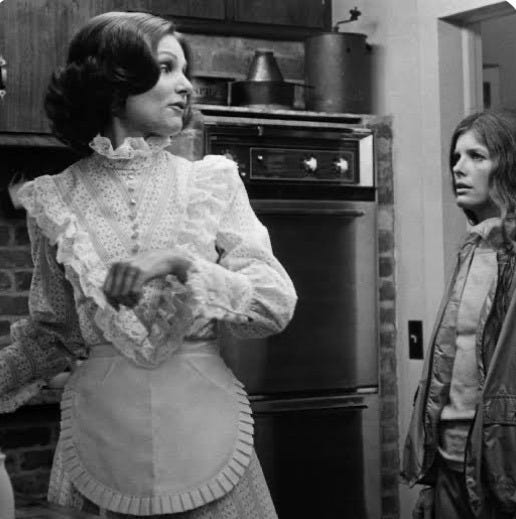
Still, I am feeling dislocated, as if I’m hovering above my Self down there in my tidy little ranch house in New England, with my wife and my dog and my cats, going about our business. But looking down into this diorama of mundanity, things are a bit off: everything is a little hazy, as though someone smeared the lens with Vaseline. We’re all ambling around, banging into things, like Paula Prentiss in that scene in The Stepford Wives when Katherine Ross stabs her with a kitchen knife and she just keeps going, but her internal wiring has come undone and she drops all the coffee mugs and spills the grounds on the floor. I thought we were friends. I thought we were friends. We’re all going about our business, pretending that everything is normal — it’s dinnertime, so let’s sit on the couch and go through the mail while the pasta water boils; it’s laundry day, so Susan is folding underwear while we listen to music — but it’s not normal at all.
It’s very, very not.
But all of these truths and practices that have been in place since The Great Experiment began have been dislocated and detached. The ball no longer fits into the socket. The old rules no longer apply.
We are all living in a state of dislocation, even if we don’t believe we are, or we’re not aware of it. We’re going through the daily grind of our lives — laundry, cooking, getting the kids onto the school bus, doing our work, staring at our little screens — unaware that the great, cosmic ball has come out of its socket. We’ll all just keep going because we always just keep going, but eventually, our bodies are going to start to feel a little weird; we’ll get clammy and maybe a little queasy, and we’ll forget for a minute where we are and what we’re doing and why. If we get to that point without losing consciousness, we’ll have reached the boiling frog stage, when it is too late to do anything. And that is what this is all about.
When the late Joanna Macy said We are in a space without a map, she was talking about being in a state of systemic dislocation. In Emergence Magazine, Macy wrote
With the likelihood of economic collapse and climate catastrophe looming, it feels like we are on shifting ground, where old habits and old scenarios no longer apply. In Tibetan Buddhism, such a space or gap between known worlds is called a bardo. It is frightening. It is also a place of potential transformation.
It is impossible to repair a dislocation without profound, blinding pain; I know this for a fact. When my mother suffered a catastrophic fall in early August and went from bad facility to less-bad facility, ultimately landing in a hospice so wonderful that it gives me hope for humanity, my mother, I, and my wife were all living in the bardo, traveling through one temporary place to get to another. I could do a lot of things: I could make sure my mother’s last days were pain-free and that she was kept comfortable and clean, and that people spoke to her with kindness and respect. It was her time, but she hung on by her fingernails, as she always did to everything and everyone around her, refusing to let go out of what—terror? Control? Letting go was her pain of dislocation, of being a ball wrenched from its socket. My pain — seeing my mother within days reduced from an energetic, hilarious, furious, powerful woman to a mere shell of her former self, and not being able to do anything about it the way I always had — left me breathless and woozy, the way I was when I tried to do my pendulums. In a conversation with Tricycle Magazine editor James Shaheen, Ann Tashi Slater, author of Traveling in Bardo, called bardo any stage of suspended reality.
It is impossible to map this space, because this space is unknown to any of us; we are on, as Joanna Macy said, shifting ground. The rule of law as we know it is something we’ve always taken for granted because it has always been followed, more or less. Commit a crime, and go to jail. Honor the borders and boundaries of our neighbors and friends. Allow for peaceful protest as clearly outlined in The Constitution.
But all of these truths and practices that have been in place since The Great Experiment began have been dislocated and detached. The ball no longer fits into the socket. The old rules no longer apply. While we’ve all been busy looking at our screens, our zones have been flooded. Long-held truths, laws, and practices have been rendered obsolete, and yet, we are responding to anarchy with the same kind of checks and balances that used to work in the past, but don’t anymore; they only work when they’re respected and adhered to. I laughed when New York City Mayor Mamdani posted an instructional PSA for anyone who is approached by ICE: They are not allowed to enter your home without a warrant. Really? Okay. Makes sense. Not allowed. That’s what the law says. They’re also not allowed to murder innocent women who are posing no threat to them. Not allowed? Okay. That’s what the law says.
I thought you were my friend. I thought you were my friend.
We have been literally dislocated. We have been shaken loose from our tendons and our muscles, and nothing is holding us together. The trusty roadmap that we all had tucked into our mental glove compartments is no longer valid, even though it appears to guide us to the right place as long as we follow the new road signs. Are you waving it around and frantically declaring illegality? What on earth makes us think for a single moment that those making their own rules will pull down their masks, drop their weapons, and say Gee—you know—you’re right. I’m not allowed to do that. Instead, they are saying Stop me. Just go ahead and try.
This is The Great Unraveling, which Joanna Macy described in Emergence as
an ongoing collapse of living structures. This is what happens when ecological, biological, and social systems are commodified through an industrial growth society or “business as usual” frame. I like the term “unraveling,” because systems don’t just fall over dead, they fray, progressively losing their coherence, integrity, and memory.
My Supraspinatus tendon — the one that I tore completely and ripped off the bone back in September — was frayed, and the first surgeon tried to anchor it back to the bone with two badly placed surgical staples that didn’t correlate to the injury. Hence, they failed. I can no longer think of my body in the same way, and the manner in which I used to treat it no longer works. I am in a place of personal physical transformation — a bardo — and it is extraordinarily painful. I can pretend that everything is exactly the way it always was, or I can move through the chaos to a place of radical change and attention. Here, the body is, indeed, the mirror of the world.
We are all in the bardo. We cannot return to the space we once knew; we have to look forward to a place of potential, moral sustenance, and rebuilding. I hope we make it.
Wow. What a clarifying and urgently needed read for me. It is, as you said, blindingly painful to be in the bardo but the one solace is that I get to be here with people like yourself. Thank you for this essay. I’m holding it close. 🧡 Wishing you much success on your next surgery and recovery!
Beautifully said and reported to how we are feeling! I hope you get some relief and want to thank you for your gift of verbal relief to the rest of us. It is a horrible strange world we are experiencing and navigating! Please everyone be kind to each other and above all show grace wherever you can as it is so lacking right now . Thank you Elissa !!