

anxiety soup
What to Eat When Your Cache is Full.

Years ago, I recall standing in a sporting goods store at the Queens Center Mall, staring at a display of softball mitts.
It was 1975, after school; I was twelve. I was probably wearing Smiths carpenter pants and Lil Abner boots and a Huckapoo “silk” shirt that was really polyester, judging by its fragrance whenever I broke into a prepubescent sweat. Anyway: I was standing in the store, in front of the softball mitts — the Rawlings — staring at them for what seemed like an hour, wide-eyed and unblinking and frozen, paralyzed where I stood until someone came up behind me, put their hand on my shoulder, and asked me if I was okay. It startled me; it was like they were waking me out of a deep sleep. I don’t recall what I told them. I have no recollection of how I even got home that day — I either walked (a very long walk down Queens Boulevard) or I took the subway — or what happened when I arrived; it was probably dinnertime, and I was probably fed Swanson’s fried chicken by my grandmother.
I didn’t tell anyone what had happened to me that day until I was in college, a decade later, when I went to talk to a guidance counselor after a significant breakup. A few days earlier, my mother had figured out that every phone number on my dorm floor was one digit apart, and, looking for me, called each one in succession; I sat on my bed, paralyzed, and heard thirty phones ring that Saturday night (my dorm mates were out), one after the other, until she reached the end. Then she started all over again with my neighbor, since she couldn’t reach me: I had physically removed my phone from the cinderblock wall it was hanging on. What was so dire? Had someone died? No. She just needed to fight, and I didn’t. This went on for three hours.
Tom explained it: I had experienced what is known as the freeze response—the thing that happens when the amygdala tells the hypothalamus to open the cortisol and adrenaline floodgates, creating a tsunami that sends the nervous system off-line.
I told my guidance counselor about it. He asked if anything similar had happened before, and I said yes: all the time. But that night was different, and all I could see as I sat on my bed listening to the phone ring — I couldn’t move — was the wall of softball mitts at Herman’s Sporting Goods. Tom explained it: I had experienced what is known as the freeze response—the thing that happens when the amygdala tells the hypothalamus to open the cortisol and adrenaline floodgates, creating a tsunami that sends the nervous system hurtling off-line. It shuts down completely, and the result is paralysis, either physical or emotional or both.
I’m writing this because recently — for the first time since 1981 — this happened to me again. I’ve been working: writing a new book, editing, teaching. Innocent people all over my country are being illegally detained, and disappearing. Two young people were shot in the streets of Minneapolis.I could feel the panic attack coming on; I pushed through it. The physicality of it hits like this: I can’t get warm. I shiver. I drink buckets of water, as if to flush the cortisol out of my system. I have a hard time getting my mouth to form words. My hands shake. I don’t go to the gym. I don’t walk the dog. I forget to eat. I’m starving. I can’t look at food. I eat boxed macaroni and cheese. My eyes burn as though my body is secreting some sort of poisonous chemical that keeps me from blinking.
The last time it happened, I was in eldercare hell, taking care of the very woman who called every phone on my dorm floor over and over again, searching for me that night in 1981. She is gone now, but I am surrounded by her papers, and I am emptying her apartment in fits and starts. I am up to my ears in deadlines. Nazis walk among us. My spiritual life is in a shambles, having been shaken like a snow globe when I had a Covid-related stroke in 2020. The bills are piling up. Dangerously so.
So on that late afternoon in Queens, while glaring at the word Rawlings, my body said enough, just as it did the other day.
Back in 1975, on that day in the sporting goods store at the Queens Center Mall, staring at the rack of softball mitts for what seemed to be an hour, unable to move, unable to speak, I had — unknowingly — reached my stress limit, and my sympathetic nervous system went into free fall; the home I lived in was like a war zone, a local male teacher had taken a shine to both me and my mother, I was being bullied and then ghosted in school, I was going through puberty and figuring out that I was not like all the other girls who cooed at the boys, my grades were suffering, that summer I had a counselor at camp who was straight out of Tom Brown’s School Days. So on that late afternoon in Queens, while glaring at the word Rawlings, my body said enough, just as it did the other day.
I tell this story — these stories — not to garner sympathy; this is absolutely not the point. I do admit to telling them to be heard, because anxiety can be incredibly isolating when it happens; one feels broken, wrong, and literally un-real, like what happens when Michael J Fox begins to disappear from photographs in Back to the Future, limb by limb. Just ask Dan Harris, who, in 2004, had an on-air panic attack in front of millions when he was a morning news anchor. Panic attacks are different from anxiety attacks — I had a brief spate of the former in 1997 when my stepfather died and I suddenly became my mother’s primary relationship — and they often happen without an (apparent) trigger. (Mine happened while I was eating a tuna salad sandwich downstairs from my office with a much-loved and trusted childhood friend.) For Harris, a born skeptic, it launched a search for understanding: what had happened to him? How had he gotten to that place? Years later, he founded Ten Percent Happier, a community of meditation teachers and therapists, Buddhist practitioners and thinkers who help listeners get to a place of understanding: how can they snip the wires of anxiety and panic in a hyperconnected, hyper-competitive, often inauthentic world where enough is never, ever enough, and we are all — every one of us — on overload.
I’ve come to understand that, at least for me, panic and anxiety have a similar root: my cache is full.
I’ve come to understand that, at least for me, panic and anxiety have a similar root: my cache is full. My foundation is cracking. Every single fear from my childhood — homelessness, abandonment, destitution, invisibility, kidnapping, violence, the taking away of everything I love — comes calling, topped off by the sudden late middle-aged adult terror of inauthenticity and pointlessness. Yesterday, I spoke to a friend — a brilliant editor (she had been mine at one point) — who has made a career of shepherding bestselling authors and building communities at the highest, most visible level conceivable; a few weeks ago, after huge successes and a recent promotion, she was summarily let go. She’s 65. We said the same thing: What now? Did it all even matter?
So yesterday, after weeks of running like a headless chicken, playing elder estate whack-a-mole — you do not know what this is like unless you’ve been there — trying to do a dozen jobs simultaneously, trying to stay healthy, trying to breathe through writing a new book about grief and art-making, I found myself in the softball mitt aisle at Herman’s Sporting Goods in 1975, wide eyed and shocked and even a little surprised at how completely familiar it was to be back there. All I can do now is breathe — box-breathing is my new best friend — and recognize it all for what it is, where it came from, and how to defuse it.
Recipe
Anxiety Soup
(aka Lively Up Yourself Lentil Soup from 101cookbooks.com)
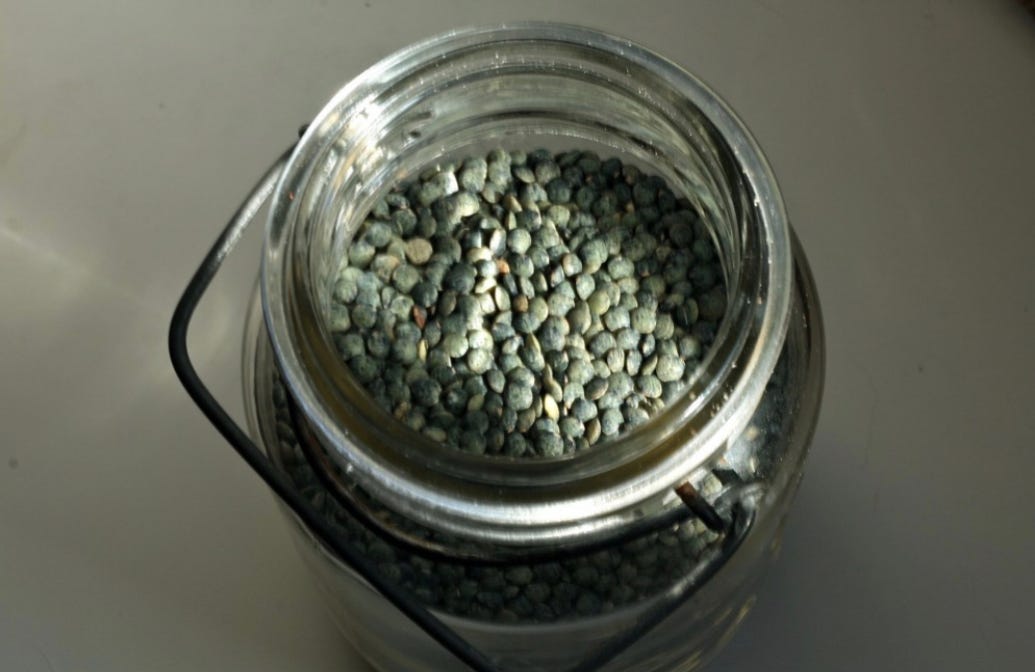
Years ago, when I was writing Poor Man’s Feast (the book), I wrote to my friend Heidi Swanson, cookbook author and founder of the blog 101Cookbooks.com, searching for a recipe that would — somehow — settle down my nervousness surrounding publication, and she pointed me to this one. I’ve since renamed it Anxiety Soup because it has the bizarre ability to quiet things down, and soothe. I have been making it for years, and for years, it has helped me feel better. You can find this soup on Heidi’s (amazing) website, along with various leftover ideas and other tweaks. Vegans: swap out the yogurt for plant-based.
2 cups black beluga lentils (or green French lentils), picked over and rinsed
1 tablespoon extra virgin olive oil
1 large onion, chopped
1 teaspoon fine-grain sea salt
1 28- ounce can crushed tomatoes
2 cups water
3 cups of a big leafy green (chard, kale, etc), rinsed well, deveined, finely chopped
Saffron Yogurt
a pinch of saffron (30-40 threads)
1 tablespoon boiling water
two pinches of salt
1/2 cup 2% Greek Yogurt
Bring 6 cups of water to a boil in a large saucepan, add the lentils, and cook for about 20 minutes, or until tender. Drain and set aside.
While the lentils are cooking, make the saffron yogurt by combining the saffron threads and boiling water in a tiny cup. Let the saffron steep for a few minutes. Now stir the saffron along with the liquid into the yogurt. Mix in the salt and set aside.
Meanwhile, heat the oil in a heavy soup pot over medium heat, then add the onion and salt and saute until tender, a couple minutes. Stir in the tomatoes, lentils, and water and continue cooking for a few more minutes, letting the soup come back up to a simmer. Stir in the chopped greens, and wait another minute. Taste and adjust the seasoning if need be. Ladle into bowls, and serve with a dollop of the saffron yogurt.
Serves 6-8
I read this once. Read it again. Thank you from the very depths of my soul Elissa for putting into words the feelings I have been experiencing lately. I too have been playing estate whack a mole for over 2 years now (the estate was sued by a selfish party who wasn't happy with his $3 million dollars), I have lost 4 furry family members in less than a year, my health is one giant question mark, and I am on empty. I stare into my cup of tea and I cannot, CANNOT even move or take a deep breath. I suffer from almost paralyzing anxiety and had a panic attack during the litigation where I thought I was having a heart attack and dying. And now - now this month. I am terrified, sad, grieving, lost, and depressed. I don't know what to do or even if I can do anything. This is paralysis and it can be utterly debilitating. There are days I wake up and want to simply scream as loud as I can. So, instead, I do the daily tasks that are menial - make the bed, wash the clothes, cook and eat meals, exercise, and hope - HOPE that I can break through this somehow. Thank you for your words....
I’m covered in stress hives. It’s been quite awhile since they’ve been this bad. But the stress is coming from all directions and I am having a nearly impossible time finding ways to get any relief and so my body is telling me that it’s all too much.